Travel Basics: Uganda
Health
Visitors over 1 year of age from yellow fever infected areas
require yellow fever international certificate of vaccination.
Exemptions are made for visitors arriving from non-endemic
areas such as Europe, North America, Australia and New Zealand.
Visitors from non-endemic areas, if traveling outside urban
areas are encouraged to obtain a vaccination. Cholera is a
serious health risk in this country and precautions are called
for. Typhoid is also widespread and immunization is advisable.
Malaria
is widespread throughout the country including urban centers
such as Kampala, Fort Portal, Jinja, Mbale and the Kigezi
area. Visitors are strongly advised to take anti-malaria medication
commencing two weeks before travel. Note that resistance to
chloroquine has been reported. Bilharzia is a risk and you
are advised not to swim or paddle in fresh water lakes and
rivers. Swimming pools in good hotels and clubs are usually
well chlorinated and maintained and are safe. Tuberculosis
and hepatitis (A, B & E) are present in Uganda.
HIV-AIDS
is prevalent in the country and needless to say prudent measures
are necessary. Good hospitals, health facilities and chemists
are only to be found in the main towns. Medical facilities
for advanced treatment including surgery are scarce even in
Kampala.
Visas
Passports valid for 3 months from date of entry are required
of all visitors. All visitors require a visa except for citizens
of some Caribbean and African countries. There are also exceptions
for citizens of Cyprus, Fiji, Malta, Singapore, Solomon Islands,
Tonga, Vanuatu and a few other countries.
Some
visas may be issued on entry into the country. It is however
advisable to obtain visa's in advance from Ugandan Embassies
and High Commissions as some airlines may require it before
allowing you to board. Entry may be refused to travelers with
no proof of sufficient funds and return or onward tickets.
Visa requirements vary from time to time and you are advised
to check on prevailing status well ahead of travel.
Peoples
& Culture
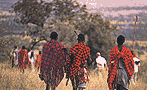
Uganda's people are complex and diverse. Bantu speakers, widespread
in east, central and southern Africa, include the Baganda
and a few other tribes. In the north, the Acholi and Lango
are Nilotic speakers and have much in common with natives
of southern Sudan. The Teso and Karamojong found in the east
are related to the Maasai found in Kenya and Tanzania. In
the west, the Ankole and Toro are culturally close to the
natives of Rwanda. The famous Pygmies are found in the forests
of the west.
As
a nation, Uganda is an amalgamation of ancient kingdoms and
independent chieftains. Among the indigenous kingdoms are
the Baganda, Bunyoro, Toro, Ankole and Busoga. The Kingdoms
were suppressed in the times of the troubles that razed the
country in the two decades after 1967. Today they have been
restored with their ancient privileges shorn and play only
a ceremonial role in the life of the nation. The Baganda king,
the Kabaka, whose domicile is Kampala has historically been
the most prominent. His lineage stretches back to the 14th
century.
Swahili,
the language originating from the east African coast is widely
spoken though not as well as in Kenya or Tanzania. Luganda,
the language of the Kabaka, is also widely spoken. English
is is understood by good numbers though only in urban areas.
For the most part, local cuisine consists of matoke (a staple
based on green bananas), millet bread, cassava, sweet potatoes,
chicken, goat and beef stews and freshwater fish. Ugali, the
maize meal based filler popular in east Africa is used as
an accompaniment for meat or vegetable dishes. You will easily
a decent locally brewed beer. Popular brands include Bell,
Club and Nile Special. The national drink is however a banana
gin known as waragi. This is a giant killer and if you imbibe
it in immoderate quantities, you will sooner come to grief.
Communications
Telephone, fax, telegram, post and Internet services are available
in urban centers. International direct dialing to many countries
is available in the principal towns. In rural areas telephony
services are unreliable. The country code for Uganda is 256.
Mobile
phones are based on GSM 900/1800 network. Coverage extends
to the principal towns. You can obtain a GSM card that will
allow you to make international calls to any country. The
main network operators are: Uganda Telecom (www.utl.co.ug),
Celtel (www.msi-cellular.com) and MTN Uganda (www.mtn.co.ug).
You will find Internet cafes in Kampala and some of the main
towns.
Accommodation
There is international standard accommodation in Entebbe,
Jinja and Kampala. The quality is variable in the smaller
towns and rated accommodation is scarce. All of the major
national parks offer accommodation in game lodges and tented
camps. See our Uganda
hotels page to view info and book accommodation
for your say in Uganda.
Money
The local currency is the Uganda Shilling (Ush). The import
and export of local currency is not allowed. There are no
restrictions on the import of foreign currency provided it
is declared on arrival. On departure, export of foreign currency
is restricted to the amount declared on entry. Visa, MasterCard,
Diners and American Express are widely accepted at bigger
hotels, restaurants, travel agencies and shops
Travelers
cheques can be cashed at major hotels, banks and forex bureaus.
You will do best when your travelers cheques are denominated
in US Dollars or Sterling Pounds. Foreign currency can be
exchanged at the Central Bank, commercial banks and forex
bureaux. Generally you will get better exchange rates at forex
bureaus. Changing money in the streets is a bad idea. Street
traders sometimes deal in funny money.
Climate
Uganda enjoys a tropical climate tempered by altitude. The
country is generally flat though the average altitude is about
1000m. Due to the rather high altitude, temperatures range
between 21 to 25°C. The mountain areas of Mount Elgon
and the Rwenzori mountains are even cooler and the top of
both mountains experiences some snow. The hottest period of
the year is from December to February when temperature rise
29 degrees Celsius. The country experiences two rainy seasons:
April to May and October to November, with April being the
wettest month. The north however has a wet season lasting
from April to October. The best times to visit are December-March
and June-September.
International
Travel
Uganda's only international airport is at Entebbe, 35 km from
the capital Kampala. Outside Uganda, the airport gained fame
as the place where Israeli commandos rescued passengers on
a hijacked plane, back in the days of the infamous Idi Amin.
The dramatic rescue captured the imagination of the world
and is the subject of a few films. There are few direct flights
to Entebbe from outside Africa and most travelers from Europe,
Asia and North America will arrive via Nairobi, the Kenyan
capital. Daily connections are available from Nairobi. Airlines
landing at Entebbe include British Airways, Egypt Air, Emirates,
South African Airways, Kenya Airways, Ethiopian Airlines,
SN Brussels, Air Rwanda, and Air Tanzania.
To
save on cost, some travelers disembark at Nairobi and take
the overnight bus to Kampala. There are two overland crossing
points from Kenya: Busia and Malaba. From Mwanza in Tanzania,
you can get to Kampala by ferry. You can also enter the country
from Tanzania through the Kagera salient between Bukoba and
Masaka. Overland travel through Rwanda, Sudan and Zaire is
uncertain due to security considerations. Make sure to check
the latest situation with the security authorities before
committing to travel.
Local
Travel
Local flights depart from Entebbe to the principal towns.
Charter flights are also available. There is an extensive
service of minibuses connecting most parts of the country
from Kampala. Bus service is rather unreliable except for
the scheduled service between Entebbe and Kampala.
Driving
in Uganda is on the left, a legacy of British rule. Rental
cars are available at Entebbe and Kampala. You need to show
an international drivers license to hire a vehicle. Roads
radiate from Kampala and are of varying quality. In the north
of the country the security situation is still doubtful and
so are the roads. It is a good idea if you are on self-drive
to get local advice about the condition of the roads you intend
to use. Review our Uganda
cars rental web page and do your booking here.
Travel
Insurance
Health and the usual travel insurance are recommended. Check
that your travel insurance Includes emergency evacuation.
What
to Wear
Light
clothing is generally adequate in Uganda. But you need warmer
wraps and sweaters for the evenings and early mornings. You
are also advised to carry some rainwear, just in case. Usually
dressing is informal. For both men and women, cotton slacks
and flat-heeled comfortable
walking shoes are recommended on safari. It is a good idea
to bring along a hat and a decent pair of sunglasses for sun
protection.