South Africa Travel Information:
South Africa has become one of the great african
tourist destinations. It is a richly diverse country of incredible
beauty, offering the traveller an abudance of exciting destinations
and attractions. The country's well-developed infrastructure, excellent
accommodation, good value for money and friendly people combine
to provide the tourist with a superb and unforgettable safari experience.
It is a country gifted with a pyramid of assets which include immense
mineral riches, enormous agricultural wealth, a vibrant economy
and a great variety of peoples, cultures and traditions.
South Africa has much to offer: thriving mordern
cities with business and industry to match the best in the world,
mordern banking and medical facilities, great sporting arenas and
a vibrant nightlife of theatres, discos,casinos,cinemas and some
of the finest restaurants to wine and dine in.
Below is some basic travel info for South Africa:-
Health
Visitors entering South Africa from yellow fever infected areas
require yellow fever international certificate of vaccination. Certain
low altitude regions in Northern Province, Eastern Transvaal (including
the Kruger National Park) and north east of KwaZulu-Natal are proneto
malaria. Visitors to these areas are strongly advised to take anti-malaria
medication before traveling.
Tap water is generally considered safe in urban
areas but not so
elsewhere. Bilharzia occurs in the north and east of the country
where
you are advised not to swim in fresh water. HIV-AIDS is prevalent
in
the country and due care is called for.
Visas
All visitors to South Africa require passports valid for at least
30 days
after planned date of exit. For those visiting for upto 90 days
no visas
are required from citizens of Australia, New Zealand, Canada, Japan,
United States, Switzerland and the European Union. There is also
visa
waiver for between 30-90 days for a few other selected countries.
But visa requirements vary from time to time and you are advised
to
check on prevailing status well ahead of travel. Visas are not issued
at South Africa border points.
People & Culture
South Africa is such a vibrant country due to the diversity of its
people.
There is a lot to be said for the wildlife and natural attractions
of this
land but you will have missed much if you have no encounters with
its
people. The Khoi-San (bushmen) are entitled to claim the to having
the
deepest roots and some of their ancestors’ rock and cave paintings
date
back 26,000 years ago.
Other prominent members of the “rainbow nation”
include Zulu, Tswana,
Ndebele, Xhosa, Sotho, Indian, Afrikaans and those of British origin.
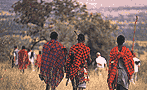
The Zulu is one of the more vibrant of traditional black cultures
and
their dance and dress is quite striking.
In historic terms apartheid has just recently been
dethroned and it is
not surprising that colour is still such as an important part of
peoples
identity. Some knowledge of English will help you get by in urban
areas and almost elsewhere in the country. Beer and brandy are the
popular routes to getting tipsy though many are increasingly finding
South Africa’s excellent wines tempting.
The music scene is vibrant and groups such as Ladysmith
Black Mambazo
are now well known in the west. The country has so many stories
to be
told as the grandees who award the Nobel Prize for literature have
recognized. The current years’ winner is Cape Town born J.M
Coetzee,
who follows in the footsteps of Nadine Gordimer winner of the prize
in
1991.
Communications
Telephone, fax, telegram, post and Internet services are available.
Direct
dialing to many countries is available at most hotels. The country
code
for South Africa is 27. Mobile phones are based on GSM 900 network
and
coverage extends to most urban areas. You can obtain a GSM card
that
will allow you to make international calls to any country. E-mail
is
accessible at Internet cafes around the country.
Accommodation
The accommodation available in the popular tourist routes is equal
to the
needs of most. From the discerning traveler who accepts none else
than
5-star luxury to the cost conscious who is happy to wake up in a
plain and cosy guesthouse.
Accommodation options encompass hotels, game lodges
and camps,
resorts, health spas, motels, guesthouses, bed and breakfasts, holiday
farms, beach cottages, holiday flats and bungalows. There are also
over
800 camp and caravan sites in the country.
Take a look at some of the accommodation available
at our Cape Town
& Garden Route hotel page:
http://www.africapoint.com/hotels/cape_town.htm
Money
The local currency is the South African Rand (ZAR). Foreign currency
can be exchanged at bureaux de change, some hotels, andlarger shops
and restaurants. Automated foreign exchange machines and ATMs are
also available at limited locations.
Travelers cheques (i.e checks) are valid at banks,
hotels, shops and
restaurants. You get the most reasonable exchange rates for US dollar,
Euro and Pound Sterling. Visa and Mastercard credit cards have the
widest acceptance. American Express and Diners Club have slightly
less acceptability.
Climate
In general South Africa has a warm temperate climate to the delight
of
many sunshine-seekers. The country experiences about seven months
of sunshine. The colder part of the year falls between May and August.
But for such a large country there are of course variations.
The coast of KwaZulu-Natal, Mpumalanga and Northern
Province are
generally hot and humid and June and July are the preferred holiday
months. Winters are generally mild except at the higher altitudes
where
there are occasional snowfalls to the consternation of those visitors
with
fixed ideas about climatic conditions in Africa.
Summer can be uncomfortably hot in the Low Veld.
The hotter areas
include the lower Orange River valley and the Mpumalanga Lowveld.
Regions in the north east of the country can get quite humid. In
Cape
Town region rainfall is highest in winter. Most of the rest of the
country
experiences the highest rainfall in the summer.
Those who have come to view game are advised to
travel in winter when
the grass is short and the animals are much easier to sight.
International Travel
Johannesburg is fast becoming a regional hub for air travel. The
country’s national carrier is South African Airways (SAA).
There are numerous direct and indirect flights for those traveling
from Europe and North America.
There are also flights from other parts of Africa,
the Far East and South
America. International airports in the country are: Johannesburg,
Cape
Town, Durban, Bloemfontein and Port Elizabeth. As Cape Town’s
stature
as a destination grows there is an increasing number of direct
international flights.
Local Travel
The road infrastructure is good and it is easy and convenient to
get
around the country by car. Self-drive and chauffeur-driven rental
cars
are widely available. Visitors must be in possession of an international
driving license. South Africa has taken after the British and driving
is on the left.
The principal cities of Bloemfontein, Cape Town,
Durban, East London,
Johannesburg, Kimberley, Port Elizabeth and Pretoria are serviced
by
daily flights. South African Airways among other domestic carriers
operates on the principal routes. Cruises offer links between the
country’s major ports such as Durban, Port Elizabeth, Cape
Town and
East London.
Rail services of varying quality link the main cities.
The luxury and very pricey Blue Train offers an express service
between Pretoria, Victoria Falls, Hoedspruit, Port Elizabeth and
CapeTown. Long-distance trains are equipped with sleeping compartments.
You should reserve ahead of travel especially for overnight journeys.
A number of bus operators run intercity express
links using modern
air-conditioned coaches.
Get to our South Africa Car Rental page to check
out what is available:
http://www.africapoint.com/cars/southafrica.htm
Travel Insurance
There are world-class medical facilities in South Africa. Health
and the
usual travel insurance are recommended
What to Wear
If you travel in summer you should pack light cottons, linens and
rainwear. For winter you need warmer clothes and rainwear if you
travel
to the Cape region. Casual wear will be adequate for most occasions.
On formal social functions however men should turn out in dinner
jackets
and black ties and women in full-length dresses.
To read more info related to South Africa travel
click on the links below:-
|