|
Tanzania Travel Information:
Tanzania's natural endowment as a
wildlife safari destination is unrivalled. Wild animals roam in
vast areas as God intended on that sixth day of the creation. These
areas are designated as national parks and game reserves and have
a high reputation for being uncrowded and unspoilt. The magnificent
collection of game sanctuaries to the north of the country, near
the border with Kenya, is referred to as The Northern Circuit. This
is the most popular and accessible wildlife safari route in Tanzania.
You can positively say that this is one of the finest game viewing
areas anywhere in the world. The game aside, the spectacularly diverse
cluster of eco-systems and habitats is a dazzling experience for
many a visitor.
Below is some basic travel info for the visitor
to Tanzania
Health
Visitors entering Tanzania from yellow fever infected areas require
yellow fever international certificate of vaccination. Exemptions
are made for visitors arriving from non-endemic areas such as Europe,
North America, Australia and New Zealand. The northwestern forest
region is considered a high-risk area for yellow fever. Malaria
is common in Tanzania. Visitors are strongly advised to take anti-malaria
medication commencing two weeks before travel.
It is recommended to take vaccinations against hepatitis
A, polio and typhoid. HIV-AIDS is prevalent in the country and I
cannot emphasize enough the need for protection measures. Some fresh
water lakes and rivers carry the risk of Bilharzia and you are advised
not to swim in such areas. Though proof of vaccination is not required,
cholera is a risk throughout the country and precautions are necessary.
Modern hospitals and chemists are available in Dar es Salaam, Arusha
and other major urban centres.
Visas
All visitors require a visa except citizens of some African and
commonwealth countries. It is advisable to obtain visa's in advance
from Tanzania Embassies and High Commissions as some airlines may
require it before allowing you to board. But you can also be issued
with a visa on arrival at Dar es Salaam, Zanzibar and Kilimanjaro
international airports and at the Namanga Gate on the Kenya /Tanzania
border. Passports must be valid for at least six months.
Nationals of countries exempt from visa requirements
will be issued with a free visitors pass at the same entry points.
Those traveling to Zanzibar should be aware that the Islands are
nominally independent and passports and Tanzania visas are required
even for a days visit. Visa requirements however vary from time
to time and you are advised to check on prevailing status well ahead
of travel.
Peoples & Culture
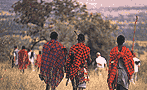
Tanzania is made up of 100 or so tribal groups of mainly Bantu origin.
None of these groups comprise more than 10% of the population and
this perhaps contributes to the tranquility the country has experienced.
The most numerous groups are the Sukuma of Lake Victoria, Chaaga
of Mount Kilimanjaro, Nyamwenzi of Tabora, Hehe of Iringa and the
Gogo of Dodoma.
Arab and Persian influence is strong in Zanzibar.
The interaction of Arabs and Bantu Africans has resulted in the
Swahili language now widely spoken in Eastern and Central Africa.
Those in the know say that the purest Swahili dialect is spoken
in Zanzibar. Swahili is now the Lingua Franca of Tanzania although
English is widely understood in urban centers.
Make sure to experience the traditional food at
the coast and Zanzibar. This is quite good and is based on seafood
and rice dishes. Food in the mainland is generally a little bit
stodgy and less exciting. The most popular drink is a very decent
brew known as Safari Lager. Tanzania music and dance is popular
throughout Eastern Africa and this attests to its quality. The lyrics
are usually in Swahili. Get to listen to some of it and this may
even help improve on your Swahili.
Communications
Telephone, fax, telegram, post and Internet services are available
in urban centers and locations popular with tourists. Direct dialing
to many countries is available at most hotels in urban areas. In
rural areas international calling is through the operator. The country
code for Tanzania is 255.
Mobile phones are based on GSM 900/1800 network.
Coverage is however limited and you are advised to check beforehand
whether your GSM phone has access if you are traveling outside the
main urban centres. Mobile telephony operators include Celtel, Mobitel,
Tritel, Vodacom and Zanzibar Telecom. You can obtain a GSM card
that will allow you to make international calls to any country.
E-mail is accessible at Internet cafes to be found in urban centres
around the country.
Accommodation
You will find good quality accommodation within the main routes
popular with business travelers and tourists. This includes Dar
es Salaam, Moshi, Arusha and the northern game parks such as Serengeti,
Ngorongoro, Tarangire and Manyara. In the parks, accommodation varies
from 5 star lodges and tented camps at the upper end to basic camping
at the lower end.
In Dar es Salaam and Zanzibar at the coast there
is a wide range of accommodation to meet the needs of most travelers.
Camping is however scarce outside the parks. Outside the main urban
centres and tourist routes finding rated accommodation is a doubtful
proposition. See our Tanzania Hotels & Lodges page to book accommodation
for your business or leisure travel needs.
Money
The local currency is the Tanzanian Shilling (Tsh). Visitors can
take in any amount of foreign currency, subject to declaration.
Taking out of foreign currency is limited to the amount declared
upon arrival. Import and export of Tanzanian currency is however
prohibited. Major currencies such as US dollars and now the Euro
and travelers cheques can be converted at major hotels, banks and
forex bureaus in the main towns and tourist areas.
In Tanzania plastic is not highly rated and credit
cards are not widely accepted. And when accepted the exchange rate
is unfavorable. But it is still a good idea to carry your credit
cards, as the conversion rate will not matter in case of urgent
need. If saying at one of the bigger hotels, however, your card
will very likely be honored. Do not be tempted to change money in
the streets however favourable the exchange rate may appear.
Climate
Zanzibar and the coastal areas are hot and humid and average daily
temperatures hover in the 30°C range. October to March is the
hottest period. Sea breezes however temper the regions' climate
and June to September is coolest with temperatures falling to 25°C.
In the Kilimanjaro area, temperatures vary from 15°C in May-August
period to 22°C over December - March. As you head to the peaks
of Kilimanjaro, temperatures can drop to below freezing, especially
at night.
The climate is temperate in the northern national
parks. The central plateau suffers a dry and arid climate with hot
days and cool nights. The highlands in the south and northeast are
cool and temperate. For the country as a whole the hottest months
are October to February. The long rains fall between March and May
and the shorter wet season falls in November.
International Travel
Tanzania's international air gateways are at Dar es Salaam, Zanzibar
and Kilimanjaro (50 Km from Arusha). British Airways flies direct
to Dar es Salaam from London, taking about 11 hours. A few European
carriers fly to Dar es Salaam or Kilimanjaro via European hubs.
Gulf Air and Emirates fly to Dar es Salaam using mid eastern connections.
Other airlines flying to Tanzania include Air Tanzania - the national
carrier, Air India, Ethiopian Airlines, KLM, South African Airways
and Swiss.
Tanzania can also be reached through regional hubs
at Nairobi and Johannesburg and to a lesser extent Addis Ababa.
There are more flights into Nairobi than Kilimanjaro and a popular
route for those heading for the northern parks is to fly into Nairobi
and then connect to Arusha by
shuttle bus service. There is a ferry service between Mombasa in
Kenya and Dar es Salaam. On Lake Tanganyika, a passenger service
runs from Kigoma to Bujumbura in Burundi, Congo (DRC) and Mpulunga
in Zambia.
The Tanzania - Zambia Railway Authority runs a passenger
train service from Dar es Salaam to Kapiri Mposhi in Zambia. But
note that you will need to change trains at the border. Tanzania
has good road links to Kenya and Zambia. Road connections to Rwanda
and Mozambique are poor and are adequate only for those traveling
for adventure.
Local Travel
All the major towns in Tanzania are connected by tarmac all weather
roads. But outside this network, quality deteriorates. You can enjoy
speedy connections by bus or car to Arusha, Morogoro, Moshi, Lushoto,
Tanga and Dar es Salaam. It is useful to find out first the quality
of the roads and estimated travel time when traveling overland.
Between Air Tanzania and Precision Air you will access the main
internal routes. Check out our Tanzania Domestic Flights page to
do your reservation for scheduled services. Charter flights are
available mainly from Arusha, Mwanza, Dar es Salaam and Zanzibar
to other parts of the country.
Rental cars are reliably available from Arusha,
Dar es Salaam and Zanzibar. See our Tanzania Car Rental page to
do your reservation for a self-drive or chauffer driven vehicle.
Rail service is available to the main towns except Arusha. Long
haul bus service can connect you to the main towns in the country.
It is advisable to find out beforehand if the quality of rail and
long haul bus service is acceptable to you. For short haul travel,
the popular way to get around is by means of dalla dalla (shared
taxi).
Travel Insurance
Health and the usual travel insurance are recommended. Ensure your
travel insurance includes emergency evacuation.
What to Wear
Tanzania never really gets cold and light clothing is recommended.
Warmer clothing such as sweaters is however necessary to get you
through the evenings and early mornings if you are heading for the
highlands. Climbing Mount Kilimanjaro of course requires special
clothing and shoes.
On safari, bright coloured clothing may get you
in trouble with wild animals. If you are wise you will pack brown,
beige and khaki clothing. Short sleeve shirts, shorts and trouser
for men are sufficient. For ladies, short sleeve blouses, slacks
and skirts are ideal though in the national
parks and touristy places such as Arusha and Dar es Salaam you may
get along with shorts (not too short) and trousers.
At the coast and Zanzibar where Muslims are predominant
women need to dress modestly so as not to offend local sensibilities.
But swimwear is perfectly acceptable at beaches and hotel premises.
Nudity is totally unacceptable in the whole country. It is advisable
to travel light and
some safari and air charters have a baggage limit of 10-15 kilograms
maximum.
To read more info related to Tanzania travel click
on the links below:
|