|
Email this page to a friend Africa Travel Newsletters > Africa's Lesser Predators > Page 2
1. Hyena's, Jackals & Wild DogsJackals are monogamous- usually, a male and a female will mate and partner
for life. The helpers assist the family in many ways; they keep
guard outside
the dens and warn of oncoming danger and sometimes they even hunt for the pups
and nursing mothers. Helpers are young jackals that have
reached sexual maturity
but have avoided breeding and stay on with the parents to help take care of
younger siblings.
Jackals normally hunt singly or in pairs, but they will labour communally
when it suits them.
Like hyenas, they hunt by chasing their prey to near death
exhaustion -biting and tearing at its behind. Once the victim dwindles, the pack
closes in
and begins to feast. Those unable to make it to the kill are not
forgotten: some of the meal is spared and delivered or regurgitated to them
later.
Jackals are cunning and every hunt is well calculated. From a herd of
prey,
the leader of the pack first singles out the weakest or youngest. The leader of
the herd or the calf's mother is usually noted and a number of
jackals sent out
to distract them. The rest of the hunters then move to surround the unfortunate
victim and the chase begins. Jackals on a hunt
thrive on the motto, "united we
stand".
They also steal
from other predators- for a pack of them can be very
irritating, and easily causes a larger predator to abandon its kill. They growl
and howl,
running around the predator in an attempt to sidetrack it off its
meal. In most cases this works, and the much smaller jackal has many times ended
up
with the dinner of mighty king lion. But this is a risky strategy, and woe
unto the jackal that is caught-up-with by a lion; it is a death
sentence.
Their varied diet includes small antelopes, mongooses, fruits,
berries,
rodents, small invertebrates, insects, and interestingly scorpions and spiders.
They are also renowned carrion foragers and livestock
thieves. On these grounds
South African farmers kill many jackals. These wild animals are a lot like dogs,
behaving and communicating in similar
ways. Jackals are prey to leopards, hyenas
and eagles.
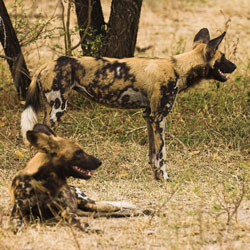 Another of Africa's lesser predators is the African wild dog- also known as
the African
painted dog, painted wolf or the hunting dog. This is very rare
animal, lives in arid areas and in the savannah and is only found in good
numbers in
Namibia, Botswana, and Zimbabwe. In East Africa, you have small
populations in Kenya's Maasai Mara, but impressive numbers in southern Tanzania,
particularly in Selous and Mikumi. In much of the rest of Africa, wild dogs are
either extinct or are on the verge of vanishing. Another of Africa's lesser predators is the African wild dog- also known as
the African
painted dog, painted wolf or the hunting dog. This is very rare
animal, lives in arid areas and in the savannah and is only found in good
numbers in
Namibia, Botswana, and Zimbabwe. In East Africa, you have small
populations in Kenya's Maasai Mara, but impressive numbers in southern Tanzania,
particularly in Selous and Mikumi. In much of the rest of Africa, wild dogs are
either extinct or are on the verge of vanishing.
The African wild dog actually is more like a dog, with long legs, raised
bat-like
ears and a huge jaw. Marked with patched patterns of various earth
colours, these dogs can easily camouflage into nature. Individuals bear a unique
pattern, which is their identity; just like the human fingerprint.
Wild
dogs are highly intelligent and social animals. They live and hunt
communally, usually in packs of 6 to 20 dogs. All members of a pack are involved
in looking after the young, most of who are born of the dominant female. The
dominant male in the pack enjoys most of the breeding privileges. Wild
dogs
weigh an average of 25 kg, and length-wise stretch about 80-110 cm.
Members of a pack share a strong bond built through play. They hunt in a
similar manner to hyenas and jackals. They have the ability to run for
long
without tiring at a steady speed of about 55 km/h. With their poor night vision,
they prefer to hunt at sunrise and sunset.
A
successful wild dog hunt
will rarely have less than 6 hunters. They hunt when very excited, and take time
to work at raising the spirits of all in
the pack. Before the hunt they
socialize among themselves, vocalizing croons and touching. This creates a
frenzied state of excitement in the pack,
and then the hunt begins!
Like warriors on a mission they follow their leader
who picks the least
likely survivor in a herd of prey. The leader charges first, with the rest in
tow. If the leader tires, another strong member
steps in his place. After the
leader initiates the first bite, the rest of the pack is at liberty to close in
and make merry. Very much like jackals,
those absent are not forgotten and are
assured of a take-away dinner.
Wild dogs are very efficient hunters and once an animal is marked, it will
almost certainly come to a sad end. They show little mercy, and will
gladly tear
a catch alive, devouring it to the last bit of flesh and occasionally bone. Most
people find this revolting and wild dogs are dogged with
a bad image.
Wild dogs are in constant competition with hyenas, and as result
they share
in mutual loathing. In many instances, wild dogs engage hyenas in a tight fight
while attempting to steal a kill. But hyenas are sharper
in this kind of game,
and in which they tend to win. Arising from such bitter memories, hyenas will
provoke a brawl with wild dogs, even when there
is no food involved.
The painted dogs are always on the move and will seldom
stay in an area for
long. In the absence of prey, they will not pass on an opportunity for a carrion
meal. They mostly hunt and eat medium-size
antelopes- such as impala and
Thomson's gazelle, and smaller animals such as rats, hares and even lizards.
Wild dogs occasionally raid livestock after straying into farms, resulting in
farmers shooting or
poisoning them. Today, this species of the African wildlife
heritage is endangered and frantic efforts are being made to safeguard and
replenish it.
The best way to see the pick of the lesser predators is by taking a combined
Kenya-Tanzania safari. This gives good value as you will also see the big cats,
and all of the other wildlife East Africa is famed for.
Help and More Information for Kenya
and Tanzania!
Planning for a Kenya safari or Tanzania
safari? Contact us
today and we will assist you in picking and booking the best hotel
and
flight, and all your travel arrangements in Kenya, or Tanzania.
Page 1 of Article on Africa's Lesser
Predators |