Botswana Travel Basics:
Health
Botswana is generally not a risky place to visit health wise. However certain
precautions should be taken. Visitors coming from areas where yellow fever is
endemic should be inoculated two weeks prior to travel. Malaria is prevalent
in the northern parts of Botswana (Chobe, Okavango, Boteti, Ngamiland and Tutume
districts/sub districts) especially during the rainy season. It is imperative
that one takes anti-malarial drugs two weeks prior to their visit. Protective
clothing, nets and insect repellants are also recommended as preventive measures.
Typhoid fever is also common through out the region and especially outside the
cities. Vaccination before travel is advisable and care should be exercised
in handling food and drink. Tap water within the cities is safe to drink but
outside the cities sterilization is advisable. Mineral water is available and
can be bought instead. Milk, other dairy products, local meat and other foods,
fruits and vegetables are safe for consumption.
Other risks are hepatitis A, B, and C, tuberculosis and Bilharzia. Trypanosomiasis
(sleeping sickness) is transmitted by tsetse flies in the western part of Chobe
National Park, Ngamiland and Moremi Wildlife reserve. Again, protective clothing,
nets and insect repellants are essential. To prevent getting bilharzia, avoid
swimming or paddling in fresh water; well-chlorinated swimming pools are safer.
There is also a high prevalence of HIV/AIDS and appropriate measures should
be taken. Dust and heat may present a problem to people with asthma and allergies.
Hats and sunscreen are recommended especially for those with fair skin. There
are different kinds of health facilities available; 23 district health teams,
3 referral hospitals in Francistown, Gaborone and Lobatse, 12 district hospitals,
17 primary hospitals, 222 clinics, 330 health posts and 740 mobile stops. Medicine
provided at government hospitals is free. There is also a private hospital in
Gaborone and also several private medical practitioners. All main towns have
well stocked chemists.
Visas
All visitors must hold a passport that is valid for at least six months, except
those with UN Convention travel documents. Visas are not required by nationals
of Commonwealth countries except those of Ghana, India, Nigeria, and Pakistan;
nationals of European countries except those of Czech Republic, Poland, Hungary;
nationals from USA, Canada and Japan. Nationals of Iceland, Switzerland and
Norway also require visas. The validity of visas by nationals the require them
is 90 days. Extensions can only be obtained from immigration offices in Botswana.
Visitors must also have outgoing travel documents such as return air tickets
and adequate funds to finance their stay. Note that visa requirements vary from
time to time and you are advised to check on prevailing status well ahead of
travel.
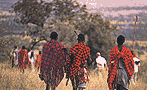
People and Culture
The people of Botswana are divided into several ethnic groups. The largest
group is the Batswana. It comprises three major tribes, the Bakwena, Bangwato
and Bangwaketse. Other tribes include the Bahurutshe, Barolong, Batawana, Bakgatla,
Bakhurutshe, Bateti, Bayei, Basubiya, Bambukushu, Bakgalagadi, Basarwa (Bushmen)
and Bakgothu or KhoeKhoe. English is the official language but Setswana is the
most commonly spoken. Some knowledge of it would prove useful.
Millet and sorghum porridge is the main dish. You will also come across morama,
an under ground tuber, Kalahari truffle which is an edible fungus and mopane
worm, a caterpillar-like grub. Traditional brews include palm wine, kgadi (made
from distilled sugar or fungus) and bojalwa (cheap sorghum beer). If one is
not adventurous enough to taste these culinary delights, the standard of food
in most hotels and lodges is very good.
Christianity and Islam are practiced in Botswana but many of the people still
practice the traditional animist beliefs.
Communications
Telephone, mobile phones, fax, Internet, telegram and fax facilities are available
in urban centers but are limited in the wildlife areas. The country code is
267. Mobile phones are based on GSM 900 network. Coverage is limited to the
main inhabited areas. Postal services are slow but cheap and are available in
all towns and larger villages. The daily newspaper is Dikgang tsa Gompieno (The
Daily News) published in Setswana and English.
Other English newspapers are Mmegi (The Reporter), The Botswana Gazette amongst
others. Radio services form BBC World Service and Voice Of America can be received
though the frequencies may sometimes change and the current ones can be found
online
Accommodation
Accommodation mainly comprises hotels, safari lodges and camping. There is
no grading system for the hotels but they all generally maintain reasonable
standards and have the basic amenities. Majority of safari lodges are found
in Chobe National Park, Moremi Game Reserve and Okavango Delta. The standards
in these are generally high with some having permanent structures and others
having tents. There are also designated camping sights in these game reserves.
However campers should exercise care when in these areas, especially at night,
due to presence of wild animals. Camping is not allowed on private land unless
prior permission is sought.
Money
The unit of currency is the Pula (P), which is divided into 100 Thebe (t).
Most hotels and lodges accept major credit cards like Visa, MasterCard, American
Express and Diners Club. They also accept travelers cheques in US Dollars or
Pounds Sterling. Exchange bureaus and credit card advances through banks such
as Barclays and Standard Chartered are available in major cities. Cash transfers
are easiest and safest done through Western Union money transfer.
There are no restrictions on import of local or foreign currencies into the
country but amounts larger or equivalent to P10, 000 have to be declared on
arrival. Banking services are available in full in all major towns while in
remote towns, there are traveling banks available weekly or monthly and they
deal more with travelers cheques than with cash. Tipping in hotels and restaurants
is not necessary but about 10% should be sufficient.
Climate
Botswana's climate is semi-arid. The rainy season is experienced during the
summer months, i.e. November to March. Very high temperatures are experienced
(they rise to 38 degrees and can reach 44 degrees in rare occasions). Rainfall
is erratic, unpredictable and highly regional but it helps in cooling things
down. The Setswana word for rain is Pula after which their currency is also
named. Rainfall decreases in amount the further west and south you go; mean
annual rainfall varies from a maximum of over 650mm in the extreme northeast
region of Chobe district to a minimum of less than 250mm in the extreme southwest
part of Kgalagadi district.
The winter season occurs between May and August. This is the dry season. The
days are sunny and cool however night temperatures can drop to below freezing
point in some part like the Kalahari. Frost is also common during this period.
The in-between periods (April to October) are the best visiting periods. Climate
is dry but cooler than in summer and warmer than in winter. Extreme temperatures
are not experienced during this period making the conditions favorable for tourists.
International Travel
The best way to gain entry into Botswana is through Johannesburg International
Airport. The national airline is Air Botswana and it provides regular flights
from Johannesburg, Harare and Victoria falls. South African Airways and British
Airways also provide flights from Johannesburg to Gaborone. The main airport
is Sir Seretse Khama International Airport, 15km from Gaborone. Other airports
that receive international flights are Kasane, Selebi-Phikwe, Francistown and
Maun International Airports.
The road system in Botswana is relatively good thus providing easy access to
the neighboring countries. Most of the roads are tarmac. Mini-buses provide
the easiest means of road travel. They depart daily during the morning hours
from the main bus station in Gaborone to Johannesburg. There are also good roads
connecting Botswana to Zimbabwe, Zambia and Namibia.
Railway transport is limited to between Botswana and South Africa and Botswana
and Zimbabwe. There are plans to extend the connection to Namibia. There is
also a ferry that provides a link to Zambia from Botswana over the Zambezi River.
Local Travel
There are scheduled regular flights between the major cities of Botswana. Charter
companies such as Delta Air, Moremi Air services amongst others provide flights
to various lodges within Botswana. However this services fall on the expensive
side. There are also several bus routes and good train lines between major towns
that provide cheaper services. Work on extending the rail network is in progress.
There are good tarmac roads linking major towns but gravel roads and sand tracks
also exist. Plans to construct more major highways are underway. Taxi services
are mainly available in major towns. Care should be exercised in negotiating
prices before embarking on journeys using this means.
For those who prefer to drive themselves, car hire services are available and
especially for 4-wheel drive cars which are necessary in many areas. Traffic
drives on the left and wearing of seat belts is mandatory. An International
Driving Permit is recommended, though not a legal requirement, for stays up
to six months. A UK license is also valid. For periods longer than six months,
a Botswana license must be obtained and can be issued without a test if a valid
UK license is produced. Public transport consists of share taxis or minibus
services operating at controlled flat fares.
Travel Insurance
Health insurance is essential. It is advisable to have a comprehensive travel
insurance policy, which covers you for repatriation to your country. It is advisable
to determine whether your insurance plan will pay directly for your health expenditures
or reimburse you later.
What to Wear
Light clothing is preferable during the day especially during the summer months.
Sun block, sunglasses and hats are essential especially for those with fair
skin. Warm clothes should also be carried due to colder nights during the winter
season and incase of rain, which is frequent during the summer, a raincoat will
be considered a good investment. Bright colored clothes should be avoided especially
during safaris to prevent any undue attention from wild animals. Natural, earthy
or khaki tones are preferable. Campers are advised to carry warm sleeping bags
and insect repellants will prove useful out there in the bush. When walking
in the bush, long sleeves, long trousers and closed shoes will prevent you from
getting tick and mosquito bites.